Showing posts with label Fungus. Show all posts

Tuesday, August 10, 2010

Highlights from the Jensen Garden

Greetings from the mosquito capital of the world! Okay, that isn't any official title, but if you have spent any time outside lately you certainly know what I mean. I am starting to think that something along the lines of a bio-hazard suit is the only way to avoid getting eaten alive. Bug spray doesn't even seem to stop the little buggers.

Someone asked why I didn't post a garden update for July. The answer: Embarrassment! On our first garden blog I admitted to being a neglectful gardener - you remember that, don't you? Our garden is a haven for weeds this year. Between the rain storms and the humidity encouraging rapid growth and the realities of being hard-working folk, we just couldn't keep up. Next year we will return to the newspaper and grass clippings method of weed control. It is biodegradable, ads nutrients to the soil, is very cost effective and reduces the weeds by at least 75% if you do it correctly. It takes a bit of effort to get this accomplished in the spring (which was the problem this year!) but we were very pleased with the results the season we did try it.

The picture in the upper left is what our garden looked like after the storms on Sunday the 8th of August. Flattened. We should still be able to harvest the corn that was ready, but the garden is in a sad state. I am very thankful that this is just a hobby and not what provides our income. It was very happy to see the acres of corn across the way from us were mostly still standing, just a few around the edges were down. We were disheartened at the sight of our little plot, I can only imagine what farmers go through when their entire livelihood is destroyed by a single storm.

In addition to weeds we had to contend with a fungus that took out the cucumber plants. This is the third year in a row we have had this issue with the cucumbers. Apparently the fungus is remaining dormant over the winter and reawakening to attack mid-summer when the plants are just starting to produce. It is a cruel fungus, killing off the plants just as your mouth is watering for fresh cucumber! According to the experts, this problem is called "brown spot" and should be treated weekly with copper sulfate. We have been directed to treat the soil with copper sulfate this fall after the plants are out of the ground to prevent it from returning next spring.

Among the weeds, fungus and bugs and a nibbling ground squirrels we have had some great garden successes. We have a TON of tomatoes this year, which is always a good thing - few things taste better than a fresh garden tomato. We harvested a few record-sized vegetables, which is exciting. One of them was a two pound, 8" long potato:


Another was an almost foot long yellow pepper:
And the last giant vegetable of the week was a 4x4 red pepper. You won't find them like this in the grocery store!


These are the finds that keep us going back day after day; fighting the weeds, mosquitoes, fungus and critters that want to gobble up what we are trying to grow!  It makes it all worthwhile when you find an exceptional vegetable to share and enjoy.

So that is what is going on in our garden. How about you?

Have a super week!

Keep it Green!

Monday, July 12, 2010

Lawn Diseases

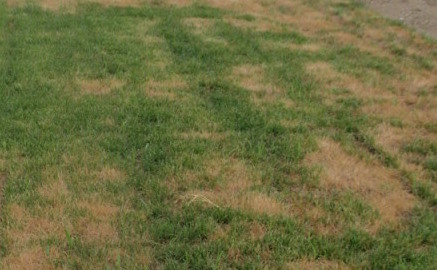
I know I promised more great tips from the Irrigation Association for this week, but I had a little mental detour I wanted to share with you. Last week we had a customer who had a lush green lawn on Saturday morning and a scary patchy brown and green lawn on Monday. What happened here?!?  One ugly word: FUNGUS.

The morning was spent on researching lawn diseases. Exciting, I know. I learned a lot, and because it can be relevant to all of you, I am going to pass along what I learned from folks along the course of my day.

"Managing Lawn Diseases" by Purdue Professor of Plant Pathology, Richard Latin, provided a wealth of information. Dr. Latin reports there are over 70 diseases of turfgrass species worldwide! Fortunately for us here in the beautiful Midwest, we only are subject to about nine of them. Five of that nine are summer diseases: Brown Patch, Pythium blight, Rust, Summer patch and necrotic ring spot. All five are especially keen on the very popular Kentucky Blue Grass.

I will not bore you with the details of each of these summer diseases, but I will tell you how to try to avoid them. There is a common thread among these summer lawn diseases - heat, humidity and mowing practices.

We can't avoid heat or humidity in a Midwestern summer, but we can utilize watering practices that do not add to what is called the "dew period" or the amount of time your yard is wet. Water early in the morning and finish up just before the sun rises. Unless you are establishing new seed or sod, avoid night time watering. A yard that never has the opportunity to be dry when evening temperatures are above 65 degrees is a yard that is providing a prime environment for fungal growth. We do know there are conditions, such as new sod, where you have to keep it wet, but if you have a well-established yard there is no reason to be watering in the evening hours. Many homeowners who do not have automatic sprinklers water their lawn when they get home from work or later in the evening. This can leave your lawn damp for hours, allowing fungus to get a foothold in your yard. Watering your lawn in the morning will allow the heat of the sun to evaporate any excess water.

Your mowing practices can impact your yard in ways you probably never imagined. I gleaned a few tips from the experts:
1) Keep your mowing blades sharp. Dull blades have a tendency to rip grass blades instead of cutting cleanly, leaving grass susceptible to diseases. A good, sharp mower blade is a simple step to a healthier lawn.
2) Mow on the same day that you water or receive rain. The turfgrass will be in prime condition and recover much more quickly from being cut.
3) Avoid mowing a wet lawn. Grass is torn instead of cut when you mow a wet lawn, which leaves your grass unhealthy and weak. Avoid early morning mowing when the dew is heavy and mowing during or just after a rain. This almost seems counter-intuitive to suggestion #2, just wait until it has dried, which can happen very quickly in the summer.
4) Do not overwater your lawn. Overwatering your lawn can be more harmful to your lawn than not watering it at all. Even in the dog days of summer your established yard shouldn't need water every day. If you have run-off when you water you are watering too long. If you have an automatic sprinkler and you are not sure if you are over watering, check with your irrigation professional to see if your controller settings are appropriate for your yard.
5) Don't mow too short. You never want to cut off more than 1/3 of the grass blade at a time. The hotter it is, the higher your mowing deck should be.

If you have a fungus you should bag your lawn clippings rather than mulch, so the spores are not being redeposited on the grass. You should also sterilize your tools and mowing deck to avoid the spread of disease. They will need to be sterilized with a solution of bleach water. Always clean and dry your tools well after any contact with fungus of any type.
 
Hopefully you will never cross paths with a lawn fungus, but every summer the conditions are ripe for you to do so. Mow smart and water smart and you should be able to avoid most fungal infections in your turfgrass.

Have a super week!
Keep it Green!