More snow?!?!?
Can you believe it? It snowed again. The second snowiest April in Sioux City history. It just seems a little crazy to all of us who are itching for spring to arrive.
Looking on the bright side, our area has moved from "Exceptional Drought Conditions" to a more "Moderate to Severe" level. This is great news for area landscapes and farmers. Also in the good news category, I heard an agronomist on the news saying that in that full 10 days of moisture we had, there was virtually no run-off. You could about hear the trees heaving a sigh of relief when those first early rains started to soak in.
Although we humans are sick of the dreary weather, it will be for the best in the long run. If we can get a dry enough run here (and the forecast looks promising!) the farmers can get their crops in, followed by another period of rain we will be practically golden. So hang tight! It is all for the greater good!
Many of you are dying to get out into your yard, get the sprinkler running and all those things that tell you that summer is on the way. Don't get into too much of a hurry. Give your yard the opportunity to dry out a litte and dig those roots in deep to look for water. If you start your watering before your grass even needs it you set yourself up for surface roots. I know we have covered that before, but I know some of you haven't listened yet, because every year we see you watering in ways that make us crazy! Besides, as of today, our techs were finding ice in valve boxes located on the north side of properties. Frozen sprinklers won't run. If the forecast holds true we will finally get some sunny and warm days. (Hooray!) The trees are going to explode with color and the grass is going start it's growth cycle. Keep in mind that even though the sun is shining and everything is coming out of dormancy, watering is not an immediate need. So be patient, the season has just begun.
One final note - If you didn't get your spring fertilizer on before all this wet weather, be sure to get your sprinkler up and running before you apply the chemicals. Every year we get a handful of calls from panicked individuals who have fertilized and then discovered that have a non-functioning irrigation system. We encounter such a huge volume of calls in the spring, the odds of us getting your call picked up within the "water in 24 hours" window are slim to none. So this year, do us both a favor and make sure your system works before you break out the fertilizer spreader.
Keep it Green -
Wednesday, April 24, 2013


Monday, April 15, 2013
Wild and Wacky Spring!

Wild and Wacky Spring!
Wow! Has Mother Nature been having some serious mood swings in the last few weeks!We have seen several types of weather, sometimes in the same day! Looks like after this week we should settle down a bit. I am very thankful for the moisture, which has moved us out of the "extreme drought condition" category, but am ready a little more moderate weather patterns!
It is interesting to me how things change from one year to the next. Last year was crazy hot really early in the spring. We were starting sprinklers earlier than we ever had before. Our fruit trees all blossomed out early, then we got a frost, the blossoms all died and we didn't get any fruit (two years in a row that happened!) This year, here we are at April 15th, which is our average start day, still not starting sprinklers. You just never know how things are going to go here in the Midwest!
The good news is that you have had extra time to make sure all your summer equipment is ready to go. The lawnmower blades should be good and sharp and the mowers and trimmers all tuned up and at the ready. What? You haven't done that yet? Better get on it! Won't be too long before you will be needing those!
I took advantage of the milder days to prune some dead wood out of some trees and bushes on the property. The early bloomers are just starting to fatten up, so it is quite easy to see which branches will be producing this year and which ones are needing to be cut loose. My lilac bushes look so much better. I look forward to having them in full bloom.
Many of you will be applying spring fertilizer in the next few weeks. Remember, make sure your sprinkler is fully functional BEFORE you apply fertilizer. Every year we get panicked phone calls from people who have applied fertilizer that needs to be watered in and then discover that they have winter damage to their sprinkler. Plan ahead and save yourself the emergency call fee that can arise from this situation.
Hang in there all you winter haters! Spring will arrive soon!
Keep it Green!
Have a super week!
Tuesday, March 19, 2013
Spring Pruning

Early Spring Pruning
We posted on our Facebook page earlier this winter about making sure your trees were pruned prior to spring. Now that spring is quickly approaching and I can clearly see some tree buds starting to swell, you need to get to work on some of the shrubbery on your property.
Each of the following plants are commonly found in Siouxland yards and can be safely pruned in the early spring.
- Butterfly Bush (Buddleia Davidii)
- Flowering Dogwood (Cornus florida)
- Fall Clematis (Clematis terniflora)
- Honeysuckle (Lonicera fragrantissiam)
- Hydrangea, Peegee (Hydrangea paniculata ‘Grandiflora’)
- Potentilla (Potentilla fruticosa)
- Spirea (except Bridal Wreath) (Spirea japonica))
- Wisteria (Wistera species)
If you have one of these, clean and sharpen your pruners and give them a trim before they start to grow. Frankly, I cut my Fall Clematis to the ground every spring and I am always amazed at how HUGE it is in the fall. The first time I did it I was terrified, but the results were fabulous, so now it is an early spring ritual.
Before you run outside and butcher all your shrubs, I wouldn't reccomend you hack all these plants to the ground!! Each has individual needs,so do a little research first. I have found the Monrovia website to be very helpful with information on specific plants. About.com also has a "How to Prune Your Shrubbery" article. Or visit your local garden center for advice. Here in Siouxland, John Kluver at Earl May has a weatlth of knowledge about plant care and is always delighted to share what he knows.
Enjoy the milder weather!
Keep it Green!
Thursday, March 7, 2013
Have you created a beast?

I have left you alone for far too long! We had the craziest seaon in our twenty-three year history last year. There wasn't hardly time to take a coffee break much less write a blog post. We do hope that this year is a little more manageable than last.
We had horrible dry conditions last summer, which was a huge coin flip from the flooding the summer before. Mother Nature can be so moody! Many people simply let their yards die last year, particularly people without irrigation systems. We know of a few that quit watering automatically as well, which seemed like a questionable choice to me.
The biggest thing we saw last year is that the yards that got watered the most during non-drought conditions, needed the most water during drought conditions. We have tried very hard over the years to educate our customers about proper watering procedures and a few just aren't listening. I am going to say it again, just in case you missed it!
Established turf grass does NOT need to be watered every day. Even in extreme conditions.
Really, truly. You did not read that wrong. If you water every day the root system of your grass remains at the surface rather than burrowing deeper into the soil to search for water. In the heat of the day if you were to dig a hole the warmest and driest dirt is at the top and the cooler more moist soil is deeper down. What you are doing by watering daily is creating a thick layer of roots in the hottest driest part of the soil.
Turfgrass that is watered daily, because of the altered structure of it's root system is also more susceptible to disease and has to be manicured more carefully. One false move with a lawn mower or trimmer and you have killed your grass. Daily watering turns your turfgrass into a water greedy beast. Spoiled grass needs more water and more care. Stop the crazy cycle before it starts again.
All this being said, please do not start off your season watering daily. Your yard does not need it.Trust me. Your water bill will decrease and the life expectancy of your well system will increase. You will waste less water - overwatered lawns have greater run off. You will mow less and your lawn will be healthier and happier.
But what if it is really hot and really dry? Do you need to water every day then? Not likely. We will talk about that another day, but in most cases the answer is still no.
Have a great day!
Keep it Green, Siouxland!
Tuesday, July 26, 2011
Hot and Dry Conditions Prevail
This is the first summer in many years we have hit an extensive hot and dry spell. It is easy to see who has a sprinkler and who doesn't, and even who has a good sprinkler and who doesn't. Yards that haven't received any supplemental water look like this right now:
This spring, and even early summer brought repeated heavy rains encouraging grass to keep all their roots at the surface. If the turfgrass never has the opportunity to establish a deep root bed it tends to stress in the heat much more quickly. Those of you who insist on watering daily even in early spring are finding that you have to water even more to keep up with your spoiled root system.
We have had several customer calls this week about properly functioning sprinkler systems. They were concerned that their irrigation system was not functioning at all because the yard was beginning to show stress. Every one of these callers still had their sprinkler systems on the same settings that were programmed when the system was started in April. April conditions are much different than July conditions, particularly here in the Midwest. When it is extensively hot and dry you need to either add watering days and/or increase your watering times. If you have a water budget feature on your controller this is where it really comes in handy. Increasing the water budget to 150%, a common setting for July and August, will add 50% more run time to your existing times for each zone and is easy to scale back as conditions warrant.
For folks who have let their lawns get extremely dry before even starting their sprinklers we recommend a cycle and soak pattern of watering. Running your sprinkler through two full cycles during the overnight hours leaving a couple hour break in between cycles to allow the water to be absorbed.
Don't you want your lawn to look like this?
A poorly designed or maintained sprinkler will certainly apply water, but it won't do it completely, efficiently or well. The easiest way to have a lush green lawn is to have a well designed, professionally installed sprinkler system. To add to the ease of owning your system, and make it so you don't have to fret about adjusting for rainy weeks and hot dry weeks, we highly recommend installing a weather based Smart control system. These controllers have become surprisingly more affordable for this year. For those of you who have a had Rain Bird sprinkler system installed in the last five years, Rain Bird has upgrade kits available for their ESP 4 Modular controller. The older your sprinkler controller is, the more you should look into upgrading. Without any effort on your part, this impressive technology will adapt the amount of water your yard receives based on soil type, slope, wind, rain, temperature and evaporation. Smart controllers pay for themselves in water savings in about two seasons, depending on the weather conditions.
Water smart and your lawn will thank you.
Keep it Green!

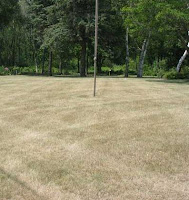 |
| Extremely dry Midwestern lawn |
We have had several customer calls this week about properly functioning sprinkler systems. They were concerned that their irrigation system was not functioning at all because the yard was beginning to show stress. Every one of these callers still had their sprinkler systems on the same settings that were programmed when the system was started in April. April conditions are much different than July conditions, particularly here in the Midwest. When it is extensively hot and dry you need to either add watering days and/or increase your watering times. If you have a water budget feature on your controller this is where it really comes in handy. Increasing the water budget to 150%, a common setting for July and August, will add 50% more run time to your existing times for each zone and is easy to scale back as conditions warrant.
For folks who have let their lawns get extremely dry before even starting their sprinklers we recommend a cycle and soak pattern of watering. Running your sprinkler through two full cycles during the overnight hours leaving a couple hour break in between cycles to allow the water to be absorbed.
Don't you want your lawn to look like this?
 |
| Lush, healthy turf grass |
A poorly designed or maintained sprinkler will certainly apply water, but it won't do it completely, efficiently or well. The easiest way to have a lush green lawn is to have a well designed, professionally installed sprinkler system. To add to the ease of owning your system, and make it so you don't have to fret about adjusting for rainy weeks and hot dry weeks, we highly recommend installing a weather based Smart control system. These controllers have become surprisingly more affordable for this year. For those of you who have a had Rain Bird sprinkler system installed in the last five years, Rain Bird has upgrade kits available for their ESP 4 Modular controller. The older your sprinkler controller is, the more you should look into upgrading. Without any effort on your part, this impressive technology will adapt the amount of water your yard receives based on soil type, slope, wind, rain, temperature and evaporation. Smart controllers pay for themselves in water savings in about two seasons, depending on the weather conditions.
Water smart and your lawn will thank you.
Keep it Green!
Friday, July 8, 2011
Watering Tip

This question gets asked a lot. Today I had to run an unscheduled mid-morning errand and in a mile long stretch of road saw five sprinkler systems running. It became clear that we need to cover this again.
Water your yard early in the morning BEFORE the sun rises. The wind is typically the most calm at this time of day and watering early in the morning allows for maximum absorption into the soil while the sun is still below the horizon.
Watering in the evening, particularly during days of high humidity levels, creates ideal conditions for breeding a variety of lawn diseases. The most common lawn disease fueled by high humidity levels is fungus. Fungal patches in the lawn can spread quickly and ruin your yard for the season.
Unless you have freshly laid sod, avoid watering mid-day. Most of water applied mid-day is lost to evaporation. Watering in the heat of the day is the least effective time to water your yard.
Depending on this size of your yard, set your clock to start sometime between 2am and 4am so the run cycles are completed before sunrise. If you are worried that you won't notice if something is broken when the sprinkler only operates in the middle of the night you can run a two minute test one evening a week and watch each zone run. That way you can keep and eye on it AND water at the right time of day.
Watering smart will keep your water bill down and your yard green.
Keep it green!
Friday, July 1, 2011
Welcome to Smart Irrigation Month!
 This spring has been a wild ride here in the Midwest. Flooding and rain and thunderstorms (Oh, my!). Thirteen of the 30 days of June had measurable rain. We have certainly had some weather that made having a smart controller or a rain shut-off device a very wise investment.
We have turned very quickly from very wet to very hot. July is typically a high water use month and with the 100 degree temperatures yesterday it is easy to see why. The Irrigation Association has deemed July "Smart Irrigation Month". We all want you to have a green grass and all the wonderful benefits that come along with having healthy turf-grass and landscapes, but we want you to be smart water consumers.
This from the Irrigation Association:
Automatic sprinklers offer convenience and control in protecting your landscape investment. Irrigation systems help you to enjoy your yard, and to keep it healthy and beautiful. However, most homeowners tend to over water their lawn or waste water through inefficient habits. Adopting water-savvy habits is essential to maintaining and extending your community's water supply, especially during peak use.How can you be a smart water consumer? Here are a few pointers.
The key to efficient outdoor irrigation is applying just enough water and only when necessary. Water-wise habits will result in a healthier lawn and landscape, in addition to conserving water. Plus, reducing your consumption will help reduce your water bill.
Inspect your sprinkler on a regular basis. Check for leaks, broken or clogged heads, and other problems, Clean drip-irrigation filters as needed. Don't assume that a sprinkler serviced in April will not need any repairs for the entire season - mowers, cars and kids can quickly misalign and damage heads. Be aware of any wet areas or run-off in and around your property.
Adjust sprinkler heads. Correct obstructions that prevent sprinklers from distributing water evenly. Plants and grasses grow very quickly and can block or clog heads. Keep water off pavement and structures (they don't grow!).
Consider a Smart controller or install a rain-sensor.This is an easy and ultimately cost-effective way to save water. We have had three very wet watering seasons in a row. The installation of a rain sensor or smart controller would have easily been paid for in water savings. Rain Bird has made their Smart Controller much more cost effective this year. If you have one of their ESP modular controllers that unit can be upgraded to a weather-controlled Smart controller. Our customers who have upgraded their old units have nothing but good things to say about their new controllers.
Water at the optimum time. Water when the sun is low or down, winds are calm and temperatures are cool - between the evening and early morning - to reduce evaporation. You can lose as much as 30% of water to evaporation by watering mid-day. We recommend completing your water cycle before the sun rises. Unless you have new sod, avoid watering mid-day.
Don't over water. Watering too much and too frequently results in shallow roots, weed growth, disease and fungus. Water just enough to keep your grass green. The appearance of your lawn will tell you it is time to water if you are not watering enough. The leaves will begin to wilt/curl and develop a bluish cast. It will recover quickly once water is applied. Try not to wait until your grass is browning out to apply water. The point here is to find a happy medium.With all the rain we have been having the grass will panic very quickly now that the heat has been cranked up.
If you are unsure if your sprinkler is running at peak efficiency, have it checked by a professional.
Keep it green!
Subscribe to:
Posts (Atom)